Interesting article on ZDNet about a recent competition administered by Facebook's AI researchers, with help from Microsoft and others, to show the state of the art in chatbots. The overall result was "soul-crushingly boring and nonsensical" according to ZDNet.
But an interesting perspective was then posted by one of the stalwarts on chatbots.org, who, recognising that most of the bots tested were "modern" ones developed by commercial start-ups and based around machine learning/neural net algorithms said "This reinforces my belief that using a neural network for a chatbot instead of being rule based is simply not an option. I have yet to see any neural net based bot that was any good.".
Think I'd tend to agree.
CLAIRE - Confederation of Laboratories for Artificial Intelligence Research in Europe
There is an interesting move underway to establish a pan-European AI research federation - a sort of decentralised CERN for AI.
From their website:
"CLAIRE is an initiative by the European AI community that seeks to strengthen European excellence in AI research and innovation. To achieve this, CLAIRE proposes the establishment of a pan-European Confederation of Laboratories for Artificial Intelligence Research in Europe that achieves “brand recognition” similar to CERN."
"The CLAIRE initiative aims to establish a pan-European network of Centres of Excellence in AI, strategically located throughout Europe, and a new, central facility with state-of-the-art, “Google-scale”, CERN-like infrastructure – the CLAIRE Hub – that will promote new and existing talent and provide a focal point for exchange and interaction of researchers at all stages of their careers, across all areas of AI. The CLAIRE Hub will not be an elitist AI institute with permanent scientific staff, but an environment where Europe’s brightest minds in AI meet and work for limited periods of time. This will increase the flow of knowledge among European researchers and back to their home institutions."
CLAIRE itself is not yet funded but sees "HUMANE AI, the FET Flagship Project Proposal for New Ethical and Trustworthy AI Technologies to Enhance Human Capabilities and Empower European Citizens and Society, is a key component of the CLAIRE vision for European excellence in Artificial Intelligence."
Nick Bostrom on Superintelligence
Good 2015 TEDTalk by Nick Bostrom on superintelligent AI. Like the diagram showing that its really hard work getting to mouse level, then even more to chimp level, then even more to most stupid human, but then almost instant to smartest human and beyond.
Fable Studios "pivots" into Virtual Beings

We blogged about Fable Studio's Lucy a few months ago after a trip to Montreal. Now here's the latest on them from RoadToVr view OpposableVR.
Road to VR - "Fable, founded by former Oculus Story Studio alumni, today announced a distinct pivot in their focus, moving from an immersive storytelling studio to a “virtual beings” company which plans to build persistent, AI-powered, characters which can interact naturally with viewers.
Fable introduced itself a year ago as a character-driven immersive storytelling studio, at the time revealing its first VR experience dubbed Wolves in the Walls, which was prominently built around protagonist Lucy, a character created by the studio. At the time the studio clearly expressed its interest in making Lucy a reactive character and one that would be persistent across several experiences and platforms.
Now the company is pushing even further in that direction, dubbing itself a “virtual beings company” rather than an immersive storytelling studio. The idea, says Fable co-founder and former Oculus Story Studio alum [ed - and VRWC17 speaker] Edward Saatchi, is to imbue the character Lucy with AI and natural input such that each viewer can have unique interactions with her, with the potential for those interactions to become part of Lucy’s memories which could color future interactions..."
Book review from Professor Richard Gilbert

Another great review, this time from Professor Richard Gilbert, Professor of Psychology and Director of the Psychology and New Technology Research Lab, at Loyola Marymount University, Los Angeles, California. Professor Gilbert staged one of the first covert Turing Tests in a virtual world which achieved a 78% deception rate.
David Burden and Maggi Savin-Baden’s Virtual Humans offers a thorough, research-based treatment of how digital entities with human-like features and capabilities have left the domain of science fiction and are rapidly becoming a major aspect of human culture. In their clearly-written and well-organized work, they describe the current forms and abilities of virtual humans (including smart speakers and virtual assistant systems like Siri, Alexa, and Cortana and various types of Internet-based chatbots); examine how the creation of virtual bodies, senses, and minds can be combined to create virtual humans; and consider potential developments in the nature and functionality of virtual agents across a range of timeframes from the end of the next decade to the end of the century. Significantly, the authors recognize and discuss the great ethical, moral and social implications of these technological developments which makes their work relevant and important for the social sciences and humanities as well as the domains of computing and information sciences. I certainly intend to use Virtual Humans as an assigned reading in the interdisciplinary courses I teach on the personal and social impact of leading-edge digital technologies.
Virtual Humans now available on Google Books!
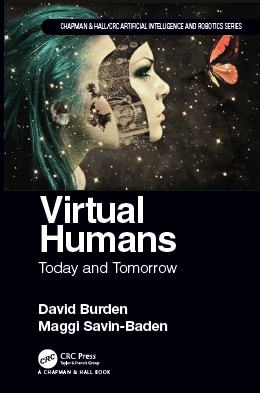
With a week or so to go before print publication you can already read Virtual Humans (or at least some of it) on Google Books! Enjoy!
Subscribe to:
Posts (Atom)